

The Lord of the Rings is Obsolete
Ratio of the Senses is to blame

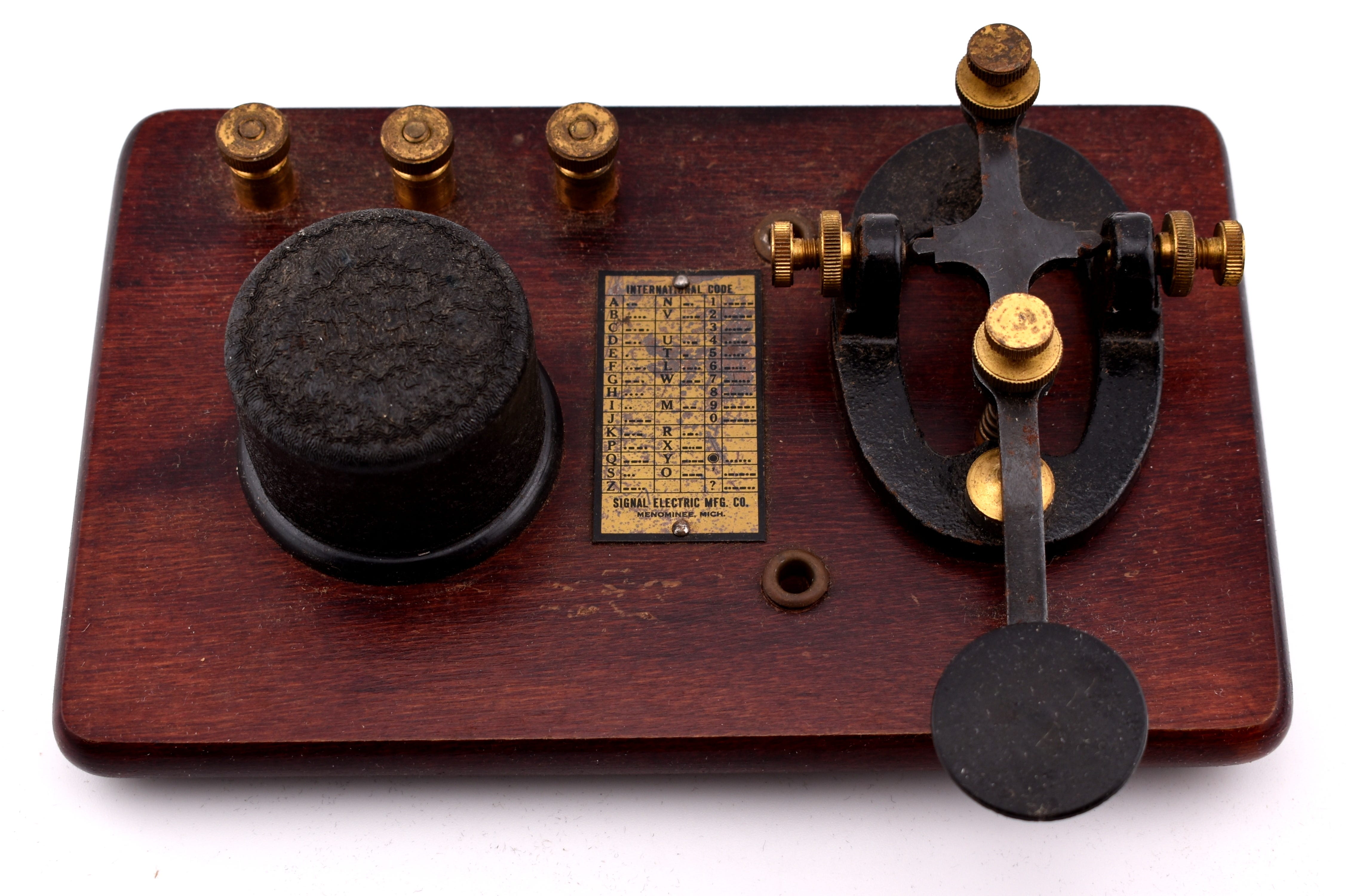
Signal Telegraph Set image by Joe Haput CC BY
Conversations with Cosmic Poet Simon Pole
The Spoken Whole: Hello Simon.
Simon Pole: Hello.
TSW: Since this is our first visit, let’s briefly sketch out the project, our purpose really. What is it, what do we want to do here?
Simon: The landscape is changing. What McLuhan called the “ratio of the senses” is in adjustment. By that I mean, the media we take in affect different parts in us: radio the ear, print the eye, television the central nervous system and so on as McLuhan described. The mix you have in a society changes both how that society conducts itself, and how the person in that society feels, thinks, and even experiences the world.
Radio is what McLuhan called a “hot” medium, it imposes itself on you. The example he cites is Nazi Germany, which apparently had radios everywhere haranguing you, and imposing the regime on you. Print, on the other hand is “cool”, it requires more concentration and participation in decoding it. You’d expect societies invested in print, and their citizens, to be less agitated, more inward-looking. And this is exactly what you get.
When you understand those differences, you can grasp how the mix of media in a people, what’s dominant, what occupies a lesser share, will mold the character of that people at all levels. In fact, McLuhan actually believed you could manipulate the tenor of a society by say increasing the amount of content delivered by radio, and decreasing the amount found in a printed newspaper. I used to scoff at this part of his thought, but when you consider the changes wrought by social media in the last decade, it’s clearly true.
TSW: So this is the ocean we all swim in, both the audience and the poet, writer, artist, whatever, who creates for that audience. What we are wired to receive has changed.
Simon: Yes, and you can see it in the word you used: “creates”. Increasingly the word “creator” is used instead of “writer” or even “artist”. The jury is still out on the value of the word “poet”. Perhaps it will keep its currency, or even gain new worth. But use of creator is significant, because what does it echo?
TSW: The deity who created earth in seven days?
Simon: Exactly. And the Creator spoke the world into existence: “Let there be light”. He didn’t write or paint. Artist was the term in the near past that used to be aspired to, such as “pop artist” or “musical artist”. Now it’s creator. And that reveals a decisive move away from print, and older forms of non-print media.
TSW: You mentioned speech, and implied the vocation of poet could maintain its worth. You seem to be connecting the two. That is, in the new landscape...
Simon: Or the new ocean where we all swim.
TSW: Yes, ocean better describes the feeling our new “ratio of senses” gives us, doesn’t it? Landscape emphasizes the “eye” of the artist and distance too much.
Simon: I regret I used the word at the beginning of the conversation.
TSW: In the new ocean of social media, and even the older electric media both audio and visual which the internet has swallowed up, what can the poet do, what must he do?
Simon: I think you are asking about his craft, what must he “create”--and it’s good to use the language of the Creator, because that is the environment we’re in. But in order to conduct his craft, the poet relies on his senses, or to say it another way, his sensibility and experience of life as he receives it through his senses. This is what is furnished into a poem. For his craft to be true, to express what is happening in his time, it must be in sync with his times. Which means his senses must be in sync with his times. This is where the poet has an advantage, for example over the novelist. A poet can change with the times, he can change into any time really.
TSW: Elaborate on that. Why can the poet adjust the ratio of his senses to meet the age, but the novelist cannot?
Simon: McLuhan had the idea that the literary man, of which the novelist is the exemplar, was too specialized with the over-emphasis on the eye as conditioned by print. He likened it to the smith Hephaestus in ancient mythology. To be too specialized is to be deformed in some way (Hephaestus the smith was lame)--the ratio of the senses is out of whack. Because of this Hephaestus loses his wife Aphrodite, goddess of love, to adultery with Ares, the god of war. McLuhan presents Ares as the whole man, good at everything the time of his cult valued. He is perfectly formed, that is, the ratio of senses is in harmony.
The idea is not that the poet should be Ares and swagger about like the original James Bond. The idea is to be whole, in concord with the age. Maybe strike that. Let’s revise it a little bit. Perhaps the poet should be a bit like Ares, whose power was to be respected, not cuckolded like Hephaestus. Because the danger is that to be in complete concord with the age is to give into the buffeting gales of social media, which blow people here and there. Why is this a danger? If we believe it is a danger, then we are admitting to ourselves we value what print previously provided: coherence, a storyline that steps forward, cause and effect, even if tenuous or mythic. However, if you are wedded to print, then in terms of our own time you are deformed. You are not functioning properly within it like the well-made Ares.
This is what people are worrying about when they talk about bringing back monasteries to preserve what print has produced. And perhaps if you believe novels and newspapers are the ultimate masterpieces of the human mind, then without a doubt preserving them is a very high calling. However, another way to look at it is: let the monks take care of the weak and the deformed, I’m going to be outside the wall like Ares imposing my will on the world. And the poet, though he is trained to the eye, and has been given all the gifts of print, also has access to the techniques of time immemorial, before print, and before even writing, when poetry was sound and memory. It is no accident that the oldest books of the Bible are the poetic books. They are the foundation of everything that comes afterwards.
TSW: The poet should be in the world, but not of it. Should adjust himself to the world of social media, but not be part of it. That still sounds very print-like, detachment and distance. How can you aspire to be Ares, when one is neither here nor there? A kingdom divided against itself cannot stand.
Simon: Yes, that appears to be the danger, doesn’t it? Yet, if you look deeper I think you will find there is unity in the poet, not division, even if it seems the poet is fracturing himself by having a foot in all the camps of media that have come to be not only in our century, and the last century, but perhaps since there was the first man. To understand this, we must consider what the Jesuit academic Walter J. Ong has shown us in his work on the oral epics of old.
The basis of the old epics was sound, the spoken word, or sung word. All words are at their core sound. Even when represented in a written manuscript or print they reference that sound. In the manuscript culture you would read the word out loud, and so were still to some degree immersed in that sound world, even as the bards of the old epics were. One might think that print totally divorces us from sound, but Ong tells us that the sound of the word has only moved to our imaginations. (Children being taught to read are quickly “corrected” if they mouth the words while reading silently).
So how can the poet be divided if sound underpins all media in which we work? The poet just needs to be Ares, be whole, and access all of it.
TSW: I get the seeking of unity, and how that is possible based on the original “soundiness” of words, which carries through spoken poetry, writing and print. But how can that apply to visual media that doesn’t need words at all? As you’ve said before the basis of movies, for example, is the emoting face. And the gravest insult you can cast at a visual work is to call it full of “talking heads”, the height of tediousness. Are we not in danger, and I mean the poet, of losing one of our legs and ending up like Hephaestus, since visual-heavy movies and social media are such a large part of the whole?
Simon: It is a danger, I admit that, but one I think we have deliverance from. To invoke Ong again, he shows that movies depend on a written script for their being. And from this perspective the movies are nothing more than the latest iteration of the first written art form, the Greek drama, which depended on the memorization of scripts. The word “script” is the dead giveaway here: writing, words and sound will forever be their foundation.
Perhaps social media though with its broadcast of millions of “emoting faces” everyday to the world will finally render us Hephaestus in the world of Ares? The promise of the movies as realized in social media will make the poet lame? I can only say here that what enabled the encoding of sound in writing in the first place will not desert us. Of course I mean the alphabet. Those millions of emoting faces still swim in the ocean of the alphabet itself. Though the media of our culture has tended towards the visual, the whole system of its operation depends on the alphabet. (I don’t want to say literacy, because that has heavy overtones of print). You can’t go to the moon and feed multiples of billions without the alphabet.
That, however, is an argument from utility. I think we have hope though, that even in the worst catastrophe, the alphabet would not be lost. And why is that? Because it’s just possible the alphabet was inspired by God.
TSW: That’s quite a claim, and no doubt the materialists are choking on their Wheaties this morning. How do you defend a statement like that?
Simon: All agree the origin of the alphabet is Semitic, but credit usually goes to the Phoenicians for trade and all that. But there’s a good case to be made that the alphabet was invented by the Jews while in bondage in Egypt. An alphabet based on Egyptian hieroglyphics has been found carved in to the walls of a mine where the ancient Hebrews were known to be enslaved.
If the Jews created the alphabet while in Egypt, in the period of Genesis before Joseph, then we have to be open the possibility that they were in some way inspired by God. Perhaps in the same way the Roman Empire was made ready to receive Jesus, the alphabet was made ready to receive what would be Jewish, and then Christian scripture. Israel didn’t produce the oral epics as they did in Greece, then, say, in the European Germanic world, perhaps because they were fated to have the alphabet so early.
So I don’t think God will let us lose the alphabet. It will always be there, underpinning everything, even if your purpose in life is to put an emoting face on social media. And if the alphabet is always there, the basis of our way of life, what does that promote? The unity of sound, for sound is what the alphabet transmits.
TSW: It’s an interesting time, isn’t it? Though I’m not sure if that’s a blessing or a curse.
Simon: It is an interesting time without a doubt. Though I consider it a blessing. I think a lot about why Shakespeare’s time was so fecund, producing also Milton, the King James Bible, and poets like Donne. And it’s obviously because you’re in that crucible, a hundred years or so after Gutenberg, when print has arrived, but you still have the strong presence of the older spoken and manuscript cultures which lingers. That mix unleashed so much, perhaps because of what was happening with the “ratio of the senses”.
It makes you wonder, is there a perfect “ratio of the senses” like there was a perfect Music of the Spheres in the older conceptions of the universe? McLuhan clearly thought there was something in the manipulation of the ratio, that the value of the ratio itself was important.
Maybe in Shakespeare’s time the ratio was perfect, and produced myriads of miracles of art. In our time, with a great flux redolent of Shakespeare’s time, the poet perhaps must cultivate in himself that perfect ratio. Then he can, like they say in showbiz, shoot for the stars.
TSW: Any parting thoughts, what you’d like to finish with?
Simon: Yes. The Lord of the Rings is the Iliad written by Dickens.
TSW: We’ll leave it at that. Good bye.
Simon: Goodbye.